Search in Members
Search in Members
Search in Albums
Search in Photos
Search in Blog
Search in Businesses
Search in Contests
Search in Events
Search in Groups
Search in Music Albums
Search in Music Songs
Search in Pages
Search in Questions
Search in Quotes
Search in Site Team
Search in Recepies
Search in Thoughts
Search in Videos
Search in Channels
Search in Wishes
Search in Prayers
cleaning company -
Apr 29 -
Other -
115 views -
0 Comments -
0 Likes -
0 Reviews
The modern transition away from assigned seating towards agile, hot-desking models represents a massive shift in corporate real estate strategy. By allowing employees to book unassigned workstations on demand, companies can significantly reduce their required square footage, lower their lease expenses, and encourage a more fluid, collaborative working environment. However, this architectural efficiency introduces a severe, often overlooked biological hazard. In a traditional office, an employee’s desk is their own private microbial ecosystem. In a hot-desking environment, a single keyboard, mouse, and chair might be shared by five different individuals over the course of a single business week. This constant rotation transforms every workstation into a highly efficient vector for bacterial and viral transmission.
Data collected from occupational health studies consistently demonstrates that shared computing peripherals harbour exponentially higher concentrations of pathogens than standard restroom surfaces. When an employee sits down at a hot desk, they inherit the biological residue of every person who occupied that seat before them. If the previous user sneezed near the monitor, ate a sandwich over the keyboard, or touched the desk height adjustment buttons while fighting a seasonal cold, those active pathogens remain viable on the hard plastic surfaces for hours. Without a highly aggressive, intervening sanitation protocol, the entire floor plan quickly becomes a continuous distribution network for workplace illness, leading to sharp, measurable spikes in company-wide absenteeism.
Asking employees to manage this biological threat themselves is an ineffective and highly unpopular strategy. Providing a canister of sanitising wipes and expecting staff to thoroughly disinfect their own workstations before starting their shifts breeds deep resentment. It cuts into their productive time and places the burden of occupational health directly on their shoulders. Furthermore, their efforts are almost always inadequate. A quick wipe of a keyboard does not eradicate the bacteria hiding between the mechanical keys, nor does it address the armrests, the docking station cables, or the under-desk touchpoints. True biological safety requires professional, chemical intervention.
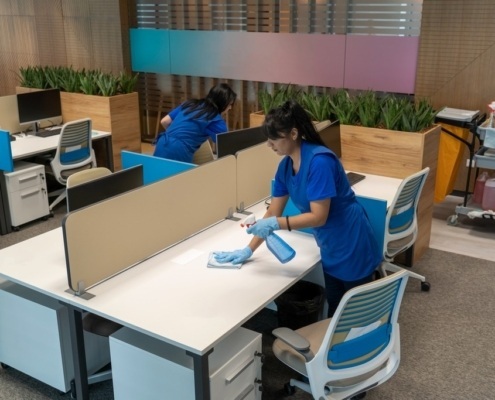
To protect the health of an agile workforce, facility managers must secure a dedicated cleaning service for offices NYC that explicitly understands the mechanics of high-touch point disinfection. These specialists use medical-grade, broad-spectrum disinfectants designed to completely neutralise pathogens upon contact. They execute a systematic, nightly reset of every single hot desk, thoroughly sanitising the monitors, the chairs, and the entire desk surface. This rigorous, methodical approach ensures that when an employee books a desk for the following morning, they are arriving at a biologically neutral, completely safe workspace.
The financial logic of this investment is clear. The primary benefit of a hot-desking model is operational cost reduction. However, if the transition to shared desks causes a twenty percent increase in employee sick days due to rapid cross-contamination, those real estate savings are instantly consumed by lost productivity and temporary staffing costs. Protecting the profitability of the agile work model requires neutralising the associated health risks. Professional disinfection acts as an insurance policy for your payroll, ensuring that your staff remains healthy, present, and capable of working at full capacity.
Ultimately, the success of an unassigned seating model depends entirely on employee trust. If the staff believes the shared desks are unsanitary, they will resist the model, refuse to come into the building, and demand the return of their private offices. By mathematically eradicating the microbial threats through strict, professional maintenance, you provide the necessary psychological comfort to make the agile transition a permanent, highly profitable success.
Conclusion
The corporate shift toward hot-desking and unassigned seating creates a severe biological hazard by turning shared workstations into primary vectors for cross-contamination. Relying on employees to sanitise their own spaces is ineffective and breeds resentment. Implementing a rigorous, professional disinfection protocol guarantees that every shared desk is biologically neutral, protecting the workforce from rapid viral spread and ensuring the long-term success of the agile work model.
Call to Action
Protect your agile workforce from the severe health risks associated with shared workstations and continuous hot-desking. Contact our sanitation experts today to establish a reliable, medical-grade disinfection routine that keeps your entire floor plan biologically safe.
Choose a test user to login and take a site tour.
Lorem Ipsum is simply dummy text of the printing and typesetting industry.
Lorem Ipsum is simply dummy text of the printing and typesetting industry. Lorem Ipsum has been the industry's standard dummy text ever since the 1500s.